The Way. The Truth. The Life.
Jesus said to him, “I am the way, and the truth, and the life. No one comes to the Father except through me.”
Catholic Pilgrimages & Spiritual Journeys to the World’s Holiest Sites with 206 Tours.

The Holy House of Loreto: Two Versions, One Miraculous Reality!
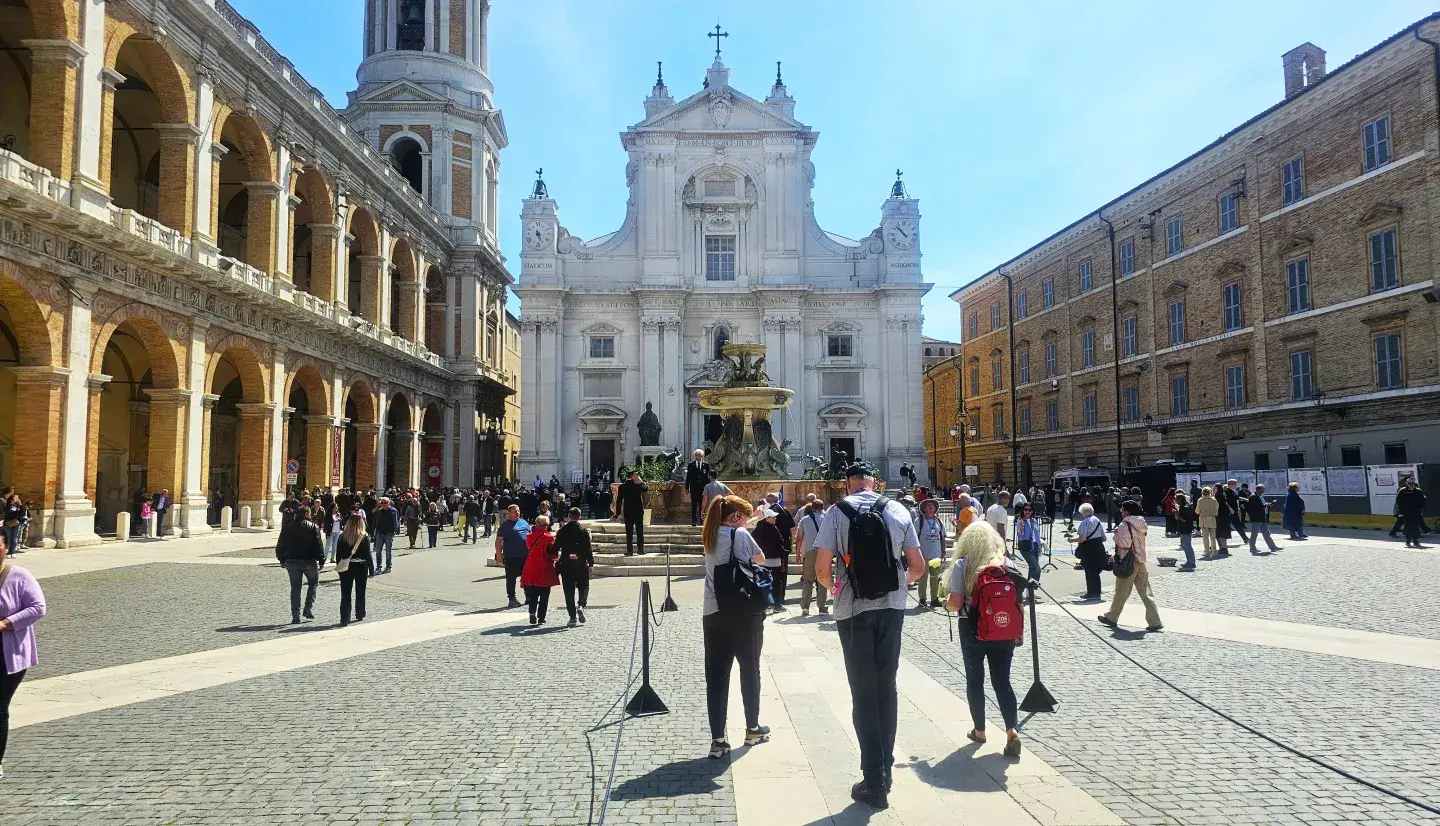
FACADE OF THE BASILICA DELLA SANTA CASA: The Basilica of the Holy House enshrines the Holy House of Nazareth in Loreto, Italy. (Photo Credit: Marissa Romero)
Written by Marissa Romero
The term “Holy House” refers to the place where it is believed that Mary accepted her role, as designed by God the Father, to become the Blessed Mother of His Son, Jesus.
When Mary responded to the Angel, “Behold, I am the handmaid of the Lord. May it be done to me according to your word” (Luke 1:38), God received from Mary the supreme response of faith.
And after her fiat, her yes, “the Word became flesh and made his dwelling among us” (John 1:14).
According to tradition, this very Holy House of Nazareth miraculously arrived in Loreto, Italy, on December 10, 1294, and the Basilica of the Holy House of Mary in Loreto was built (1469-1587) around it to protect and venerate it.
Consequently, the Catholic Church celebrates on that date the Feast Day of Our Lady of Loreto, honoring the Holy House of Nazareth, where the Word of God was made flesh for the salvation of the human family.
Moreover, since December 10 falls within the Advent season, it further encourages the faithful to meditate on the Mystery of the Incarnation of the Lord.
Two accounts offer the story of the translation of the Holy House from Nazareth to Loreto.
First Version
The first devout narrative describes angels carrying the Holy House to Loreto.
Based on this belief, Pope Benedict XV in 1920 proclaimed Our Lady of Loreto the patroness of aviators and air travelers.
However, he connected this proclamation not only to the flight of the Holy House to Loreto by angels, but also to the flight of the Angel Gabriel to the Holy House of Nazareth to deliver the Annunciation message to Mary.
Pope Francis declared the Jubilee Year of Loreto (2019-2021), marking the 100th anniversary of the proclamation of Our Lady of Loreto as the patroness of aviation in 2020, and in reference to the Holy House, he said:
“Many people come to this oasis of silence and piety, from Italy and from all over the world, to draw strength and hope.”
The flight of the Holy House symbolizes spiritual elevation, encouraging pilgrims to fly high in faith, hope, and love.
206 Tours pilgrim Beata Moeller, from Avon, Indiana, recently visited the Holy House of Loreto and knelt beneath the window where the Archangel Gabriel appeared to Mary.
“When I was kneeling and praying to Mary, I was at peace … I did not feel any pain for kneeling for a long time… I took that peace and love with me. ‘Thank you, Mary, for saying yes to God and becoming Jesus’ mother and ours,’” she said.
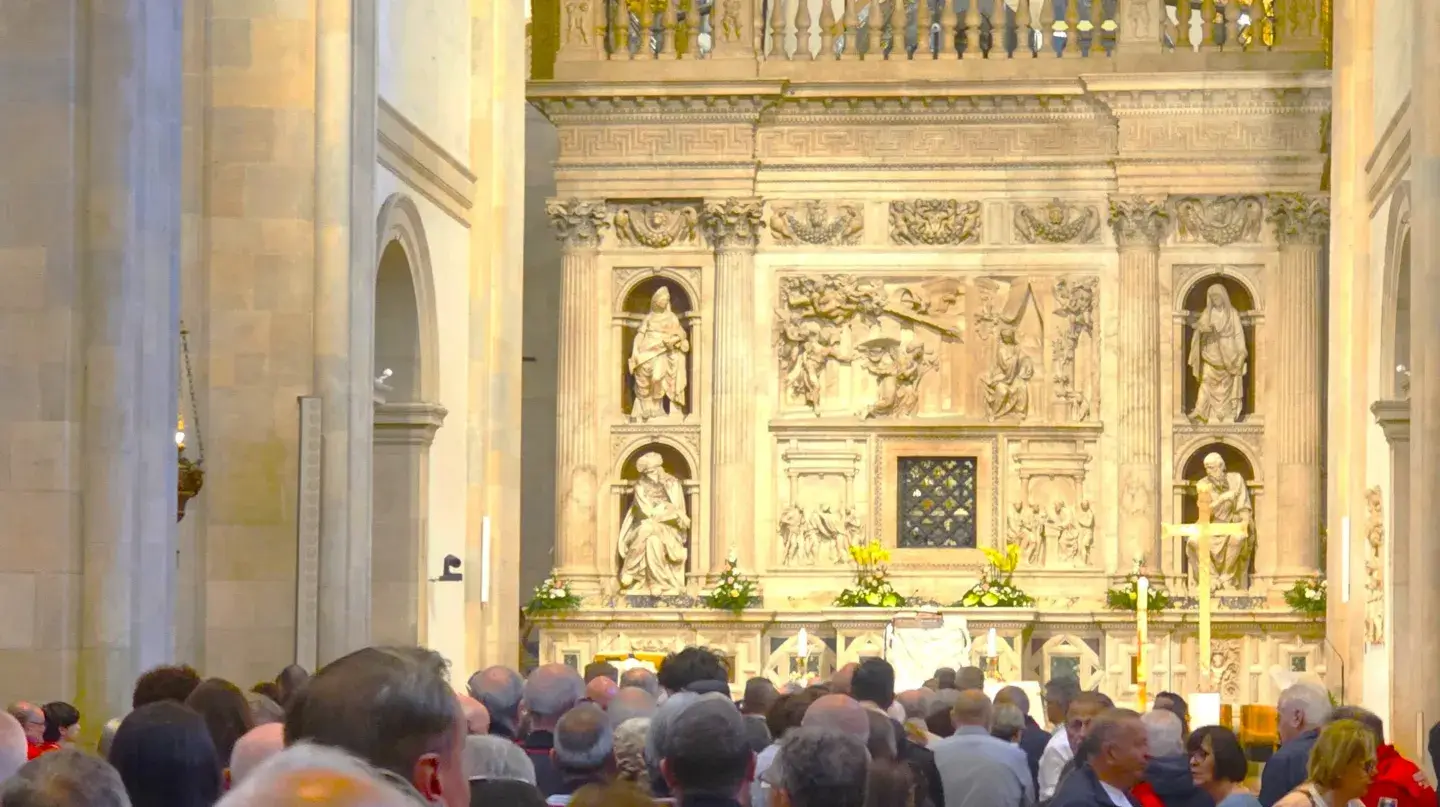
HOLY WINDOW: A structure of marble encloses the walls of the Holy House in Loreto except for the entrance and exit doors, and the Holy Window of the Annunciation. (Photo Credit: Marissa Romero)
Second Version
The second practical version describes that Crusaders and other Christians expelled from the Holy Land transported the Holy House by ship across the Adriatic Sea, funded by the Angeli Christian Family.
Since the Crusaders saved multiple relics from the Holy Land from destruction by the Muslim forces, this second account is widely accepted.
However, it is worth noting that Anne Catherine Emmerich (1774-1824), declared blessed in 2004 by St. John Paul II, in her work, Life of Jesus Christ, documented her vision of the transporting of the Holy House as follows:
“I have often in vision witnessed the transporting of the Holy House to Loretto. For a long time, I could not believe it, and yet I continued to see it. I saw the Holy House borne over the sea by seven angels. It had no foundation, but there was under it a shining surface of light.”
Blessed Anne Catherine Emmerich’s canonization process is currently in progress.
Angelic Intervention
Regardless of whether the Holy House was transported to Loreto by air or sea—both versions denote angelic intervention.
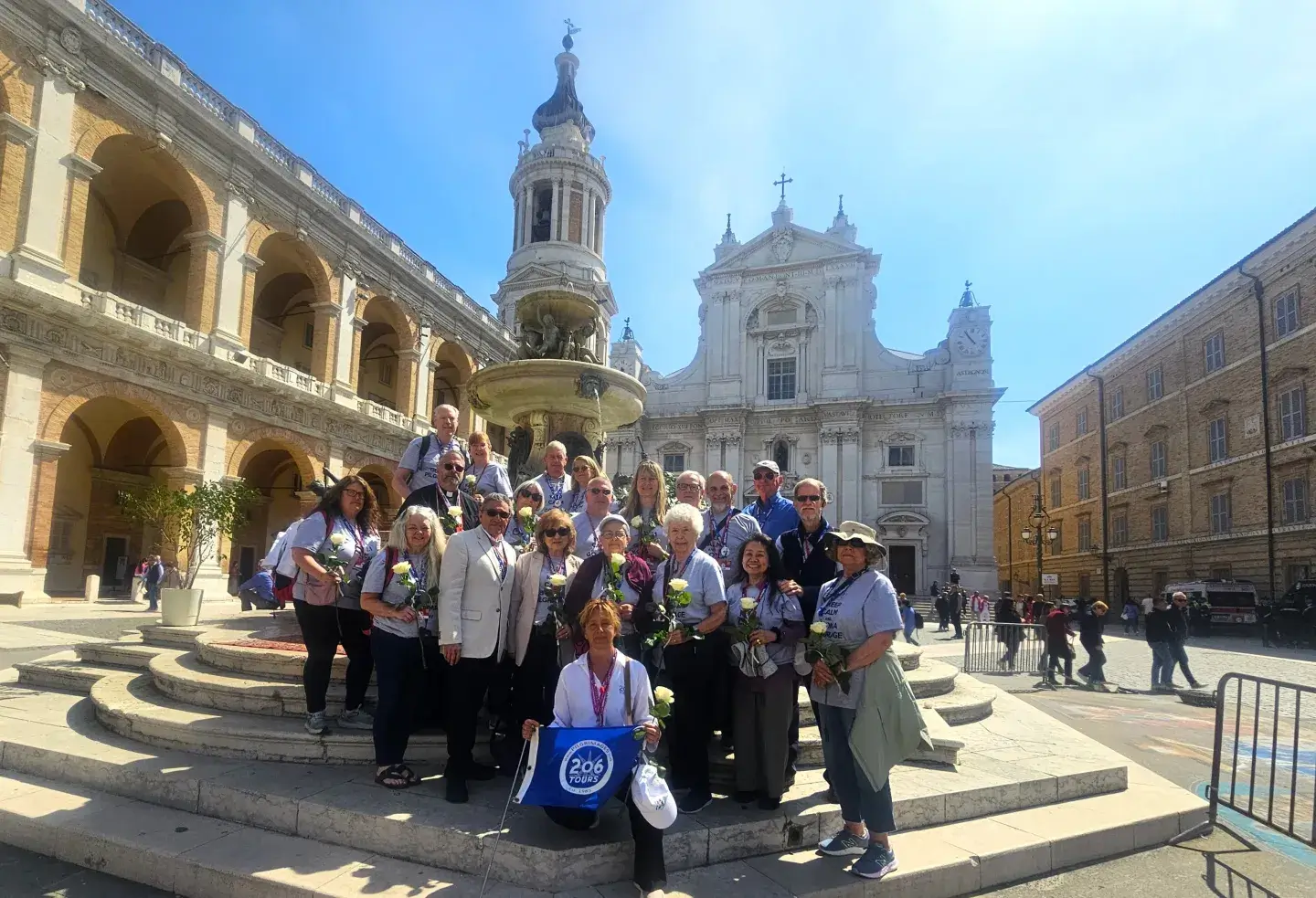
ANGELIC MOMS: 206 Tours pilgrim Moms holding white roses on Mother’s Day, May 11, 2025, during their pilgrimage to the Basilica of the Holy House of Loreto. (Photo Credit: Marissa Romero)
Authenticity
Over the centuries, data has been collected to document the authenticity of the Holy House.
Pope Clement VII (pontificate 1523-1534) sent delegates to the Holy Land to measure the perimeter of the Grotto of Nazareth. They officially confirmed that it precisely matched the perimeter of the three walls of the Holy House at Loreto.
Multilayered testing has also confirmed that the materials used in the Holy House of Loreto correspond to those found in Palestine during Jesus’ time. Moreover, these materials do not align with traditional Italian construction models, further supporting the authenticity of the relics.
“The fact that [the Holy House in Loreto] has no foundation where it stands, and that the mortar and bricks in it are of the same type that existed in the Holy Land centuries ago, are interesting facts from a scientific viewpoint, if one were thinking about ‘proofs,’” said Lyra Rufino-Maceda, Executive Director of the Chesterton Academy of St. James in Menlo Park, California. She joined the 206 Tours pilgrimage to the Holy House of Loreto in 2018.
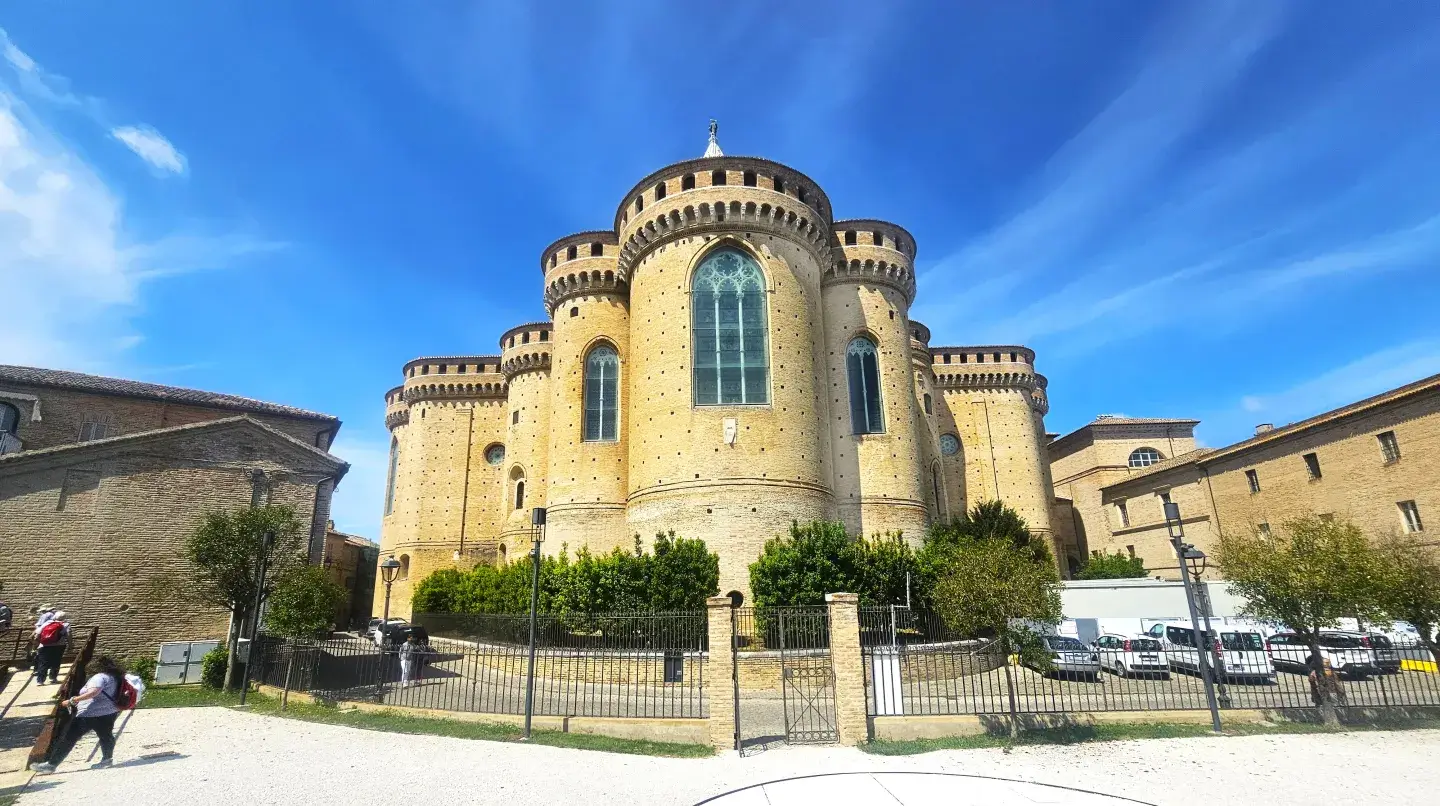
BACK OF THE BASILICA DELLA SANTA CASA: View of the back side of the Basilica of the Holy House in Loreto, Italy. (Photo Credit: Marissa Romero)
Humility
Pope Benedict XVI, during his visit to the Holy House in Loreto in 2007, said,
“[The Holy House] is the Shrine of humility: the humility of God who took flesh, who made himself small.”
He also clarified that “the way of humility is not the way of renunciation but that of courage.”
206 Tours Pilgrim Rufino-Maceda said, “The humility of Our Lord [is shown] in coming as one of us, and in particular, as a baby, entrusting Himself in the hands of His creatures, subjecting Himself in obedience to Our Lady and St. Joseph.”
Many saints have visited the humble Holy House in Loreto. In 1887, St. Thérèse of Lisieux, aware of the profound significance of this unique site, wrote that she experienced an overwhelming sense of emotion.
“I saw the little chamber of the Annunciation, where the Blessed Virgin Mary held Jesus in her arms after she had borne Him there in her virginal womb,” she said. “Our Lady had chosen an ideal spot in which to place her Holy House. Everything is poor, simple, and primitive.”
And so, even when two versions relate how the Holy House arrived in Loreto—by air or sea—this sacred place not only allows pilgrims to walk into the humble, holy physical space of the Annunciation but also to keep advancing into the pivotal moment of Jesus’ Incarnation and childhood.
Two versions, one miraculous reality!
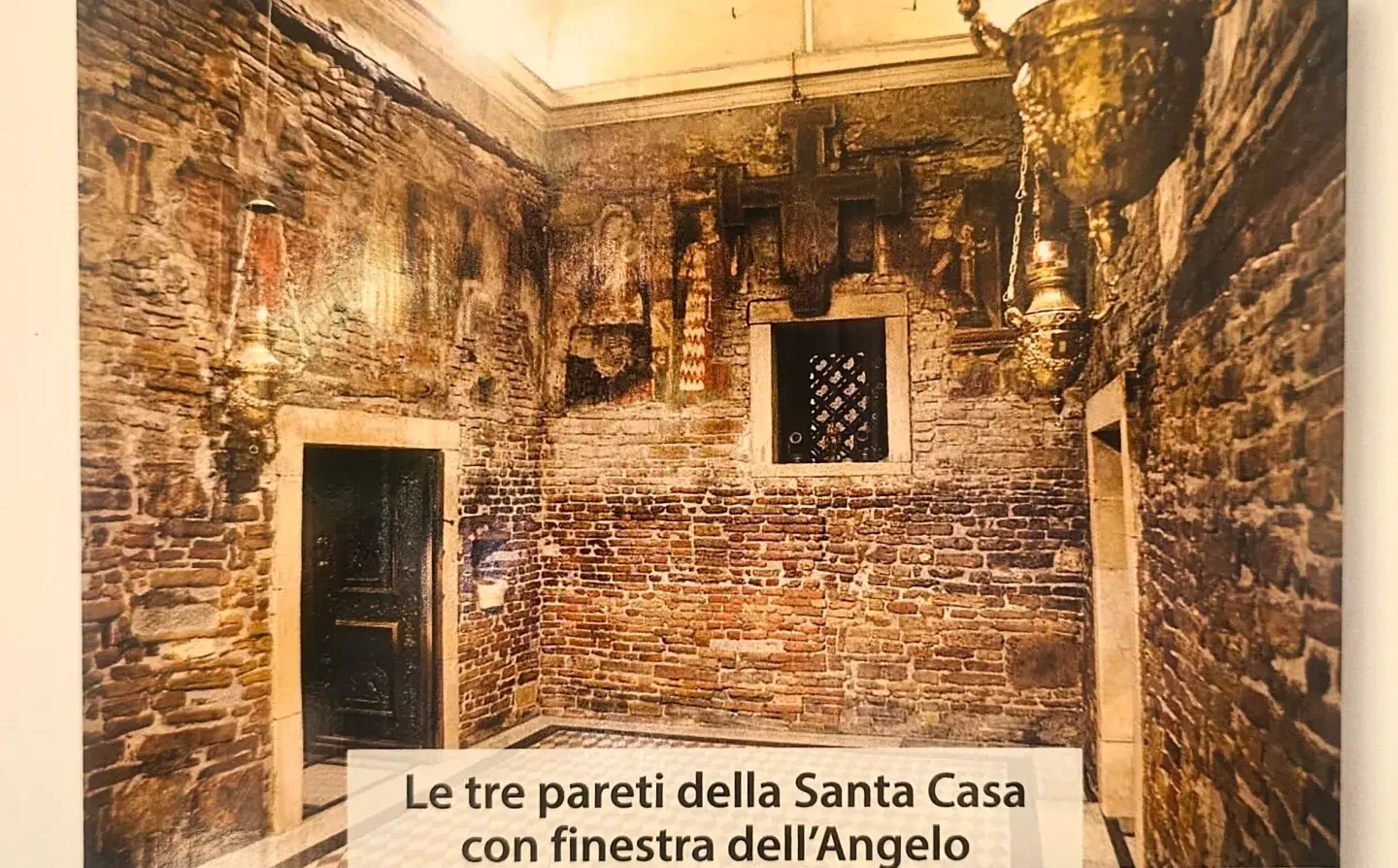
PUBLIC POSTER OF THE HOLY HOUSE: Located in one of the corridors of the Basilica of the Holy House, this poster shows the three walls of the Holy House and the window of the Annunciation. (Photo Credit: Marissa Romero)
Travel on a Shrines of Italy Pilgrimage and Visit the Holy House of Loreto: www.206tours.com/tour96
View our Pilgrimage Directory: www.206tours.com/pilgrimages
Blogs

The Holy House of Loreto: Two Versions, One Miraculous Reality!
10 Business Principles Every Catholic Company Should Follow
Pope Leo XIV’s Apostolic Visit to Lebanon
Give a Christmas Gift That Lasts a Lifetime: A Pilgrimage
Pilgrim Testimony from a Solo Traveler
Meet Pope Leo XIV: The First Pope from the U.S.
view all
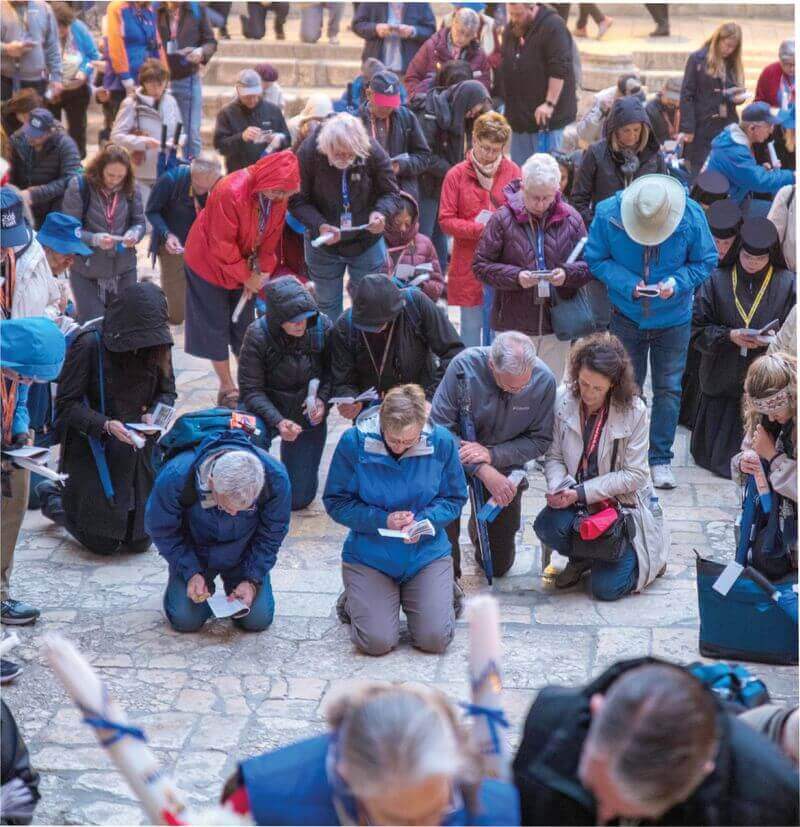
206 Tours Pilgrims
What is a 206 Tours Pilgrimage Like?
“To go on pilgrimage really means to step out of ourselves in order to encounter God where he has revealed himself” – Pope Benedict XVI
RECOMMENDED
Upon the Death of a Pope: Procedure...
RECOMMENDED
Lost Luggage: What To Do If This Ha...
RECOMMENDED
Bethlehem, Sea of Galilee & Je...
Join Us
Join over 400,000 faithful Pilgrims and get exclusive travel tips, giveaways and more!